
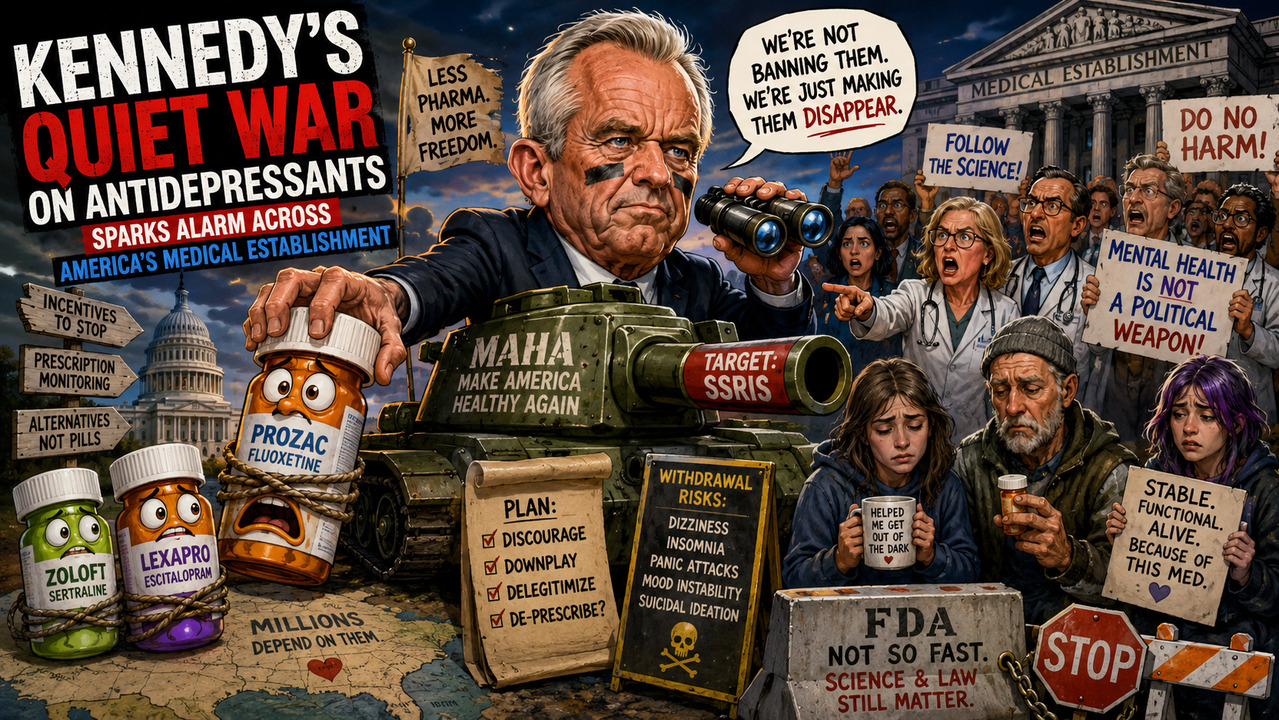
Kennedy’s Quiet War on Antidepressants Sparks Alarm Across America’s Medical Establishment
A political and medical firestorm is unfolding in Washington after reports emerged that officials working under U.S. Health Secretary Robert F. Kennedy Jr. examined whether restrictions could be imposed on some of America’s most widely prescribed antidepressants.
According to multiple individuals familiar with internal discussions, Kennedy’s team reviewed possible actions targeting medications from the SSRI class — selective serotonin reuptake inhibitors — the cornerstone drugs used for depression and anxiety treatment across the United States for more than three decades. The medicines reportedly discussed included Prozac, Zoloft and Lexapro, brands consumed daily by tens of millions of people worldwide.
The U.S. Department of Health and Human Services has strongly denied that any formal plan to ban SSRI medications exists. Department spokesman Andrew Nixon dismissed the claims outright, insisting no discussions had taken place regarding a prohibition of the drugs and describing reports to the contrary as false.
Yet the controversy intensified after Kennedy publicly unveiled a broad initiative aimed at reducing national dependence on psychiatric medication. The program includes financial incentives for physicians who help patients discontinue antidepressants, expanded monitoring of prescription trends, and new training programs intended to encourage alternatives to long-term pharmaceutical treatment.
“Psychiatric drugs have a role in treatment, but we will no longer treat them as the automatic default,” Kennedy declared during a mental health conference earlier this week, while simultaneously assuring Americans already taking the medications that the administration was not instructing them to stop.
The remarks struck directly at one of the most entrenched pillars of modern psychiatry.
Today, roughly one in six American adults takes an SSRI medication, according to recent medical research. For millions, the drugs represent the difference between stability and collapse — between functioning daily life and debilitating depression, panic disorders or suicidal thinking. The American Psychiatric Association continues to define SSRIs as the leading evidence-based first-line treatment for major depressive disorder.
But Kennedy and many allies within the growing “Make America Healthy Again” movement argue that the United States has drifted into a culture of mass pharmaceutical dependency. They contend antidepressants are prescribed too quickly, too broadly and too young — particularly to adolescents and children — while insufficient attention is paid to withdrawal symptoms, emotional blunting and long-term reliance.
The movement has tapped into a widening undercurrent of public distrust toward major pharmaceutical companies, regulatory agencies and parts of the medical establishment. That distrust accelerated during the pandemic years and has since expanded into broader debates about chronic illness, mental health treatment and the role of medication in American society.
Kennedy himself has repeatedly escalated the debate with provocative claims. He previously argued that withdrawal from SSRIs can in some cases be “harder than heroin,” a comparison rejected by many psychiatrists as scientifically unsupported and dangerously misleading. He has also raised concerns — without presenting conclusive evidence — about possible links between psychiatric medication and episodes of violence, including mass shootings, as well as risks during pregnancy.
Those statements triggered fierce backlash from psychiatric organizations, medical researchers and patient advocacy groups, many of whom warn that public fear surrounding antidepressants could discourage vulnerable patients from seeking treatment.
Mental health experts note that abruptly discontinuing SSRIs without medical supervision can produce severe physical and psychological effects, including dizziness, insomnia, panic attacks, mood instability and suicidal ideation. Doctors also warn that untreated major depression itself carries enormous risks, including addiction, self-harm and suicide.
Behind the political spectacle lies a hard legal reality: the U.S. Food and Drug Administration cannot simply erase decades-old approved medicines from the market without compelling new scientific evidence demonstrating unacceptable danger. Regulatory specialists emphasize that removing a long-established drug requires an extensive evidentiary process that can take years and often faces legal resistance from manufacturers.
Under current law, the FDA may request that pharmaceutical companies voluntarily withdraw a medication, but companies are not obligated to comply unless regulators can prove significant undisclosed safety risks or fraud in the original approval process.
That legal barrier has done little to calm nerves inside the pharmaceutical industry and the broader healthcare system. Investors, physicians and advocacy organizations are increasingly watching Kennedy’s next moves with unease, uncertain whether the administration’s campaign represents a legitimate attempt to rebalance mental health treatment — or the opening phase of a far larger confrontation with mainstream psychiatry itself.
The political timing is equally significant.
After months of friction with the White House over vaccine policy battles that risked alienating moderate voters ahead of the midterm elections, Kennedy appears to have redirected much of his public energy toward issues with broader populist appeal: food additives, chronic disease, environmental toxins, overmedication and corporate influence in healthcare.
Supporters view the shift as a necessary challenge to a medical culture they believe became too dependent on lifelong prescriptions. Opponents see something far more dangerous: a movement willing to cast doubt on foundational psychiatric treatments without sufficient scientific backing.
What began as an internal policy discussion has now evolved into one of the most explosive public health debates in America — a collision between institutional medicine and a growing insurgency that no longer trusts it.
For millions of Americans swallowing antidepressants each morning, the message from Washington has already landed with unsettling force: the medications that defined modern mental health treatment are no longer politically untouchable.